we went. A few weeks ago, at the lab, a raffle was held for free tickets to a Circus and Science exposition at
Boerhave Museum in Leiden. Of course I registered, and for once I got lucky and actually won. We had the tickets for a while now, and we noticed that the expiry date was September 4, this weekend.
"Museum Boerhaave is the Dutch National Museum for the History of Science and Medicine. In 1931 it opened its doors. It is located in the former Caecilia Hospital, in the centre of Leiden. In terms of the history of science and medicine, the collections in Museum Boerhaave are among the most important in the world. This history begins in the middle of the 16th century, which is also the time of the earliest objects on display in the museum, including the not-to-be-missed world’s oldest herbarium. As well as some original drawings and books by
Vesalius.
From the Dutch ‘golden age’ (17th century) come microscopes by Antoni van Leeuwenhoek and pendulum clocks by Christiaan Huygens, his planetarium and telescope."


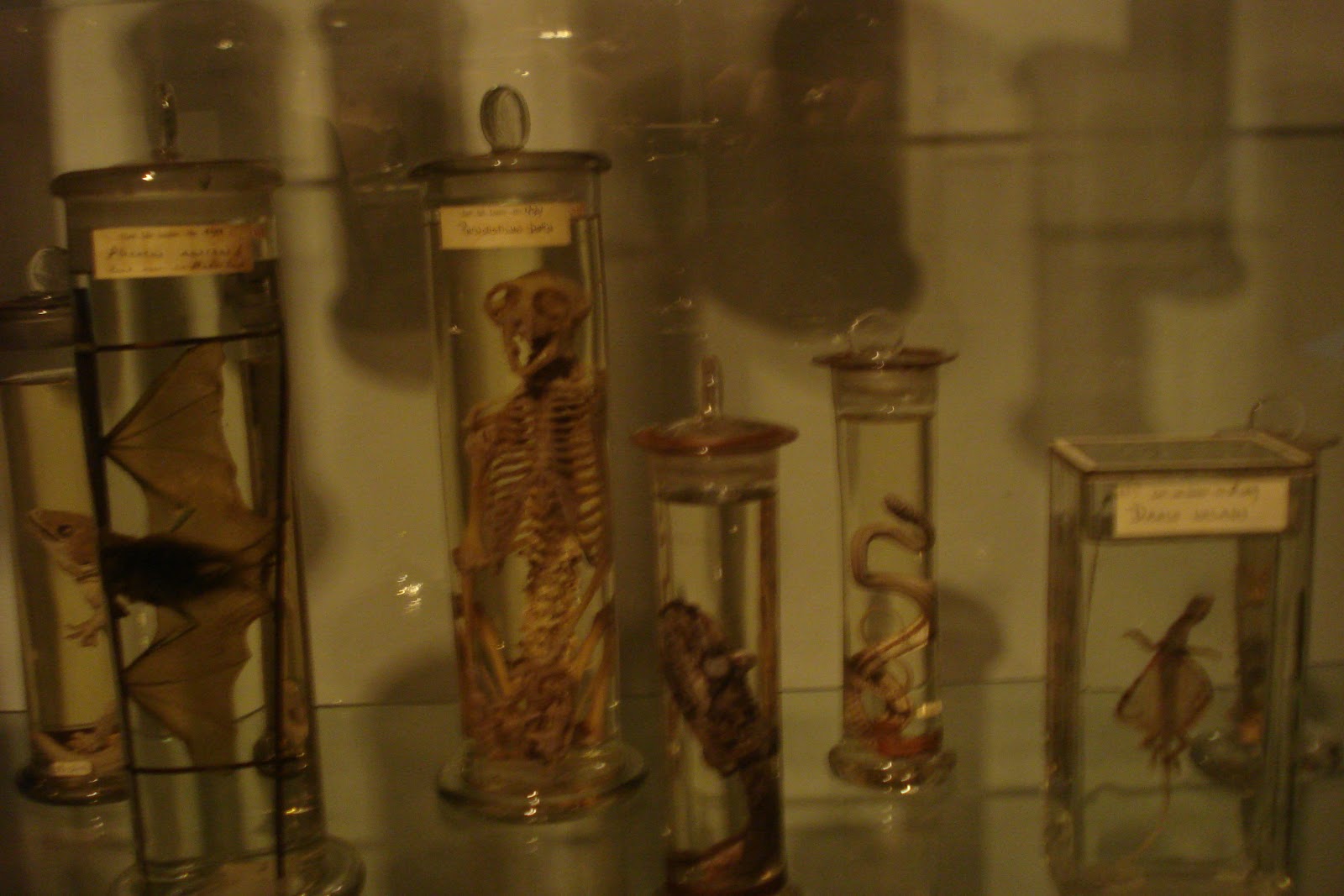
There is a wooden amphiteater complete with a dissection table in the middle and all kinds of curiosities, like a deformed piglet foetus that looks like a baby elephant. Or forceps from the seventeenth century. I was so happy that we went. Leeuwenhoek was some kind of teenage hero for me, ever since I read
"Los cazadores de microbios" (Microbe hunters) by
Paul de Kruif.
The place where the museum is located is a magic place in itself:
"The historic building in which Museum Boerhaave is located has had various functions over time. The original nunnery of St Caecilia dates from the early 15th century. Originally a nunnery, the building had become municipal property after the Reformation and shortly before 1600 was converted into a ‘plaque hospital and madhouse’. In 1635 it became an University hospital. It was here, around 1720, that Herman Boerhaave gave his famous sickbed lessons that drew medical students to Leiden from around the world. After extensive restoration, the building has been used as a museum."
I think I must have been a crazy nun in another life. I always have this feeling in my gut when I am in cloysters and old hospitals. Talking of which, if you are in Barcelona, you shouldn't miss the
Biblioteca Nacional de Catalunya , another magic and beautiful building, with a patio full of orange blossoms, that used to be a convent, medical university and hospital. It is also the place where
Santiago Ramon y Cajal discovered neuron cells.
And almost at the end of our visit, there was one last surprise, I felt like jumping up and down. (Maybe I did a bit). Because in the last room, dedicated to contributions from modern dutch scientists, there were the original sketches from
Nikolaas Tinbergen, the ethologist who won the Nobel prize together with Kondrad Lorenz, for the famous
seagull experiments*. There is even an original photo of his (of a seagull chick) and the camera he used.
*