Friday, December 9, 2011

Moments, things to do.

I am not a big fan of doing things in the very last moment available but for some reason more often than not that tends to be the case. This weekend we will be busy writing and mailing our Christmas cards and finding presents for our exchange. I do not love all the Christmas-marketed consumerism, so this year we decided to "trade" gifts in such a way that every person only has to find one present. Already in the last 3 years the boy and me did not give anything to each other, on mutual agreement, is that weird ? It's just that, it is difficult to do things when you have to. I normally love gathering little things and presents for the ones I love and I am constantly finding things like oh this could be perfect for x or for y and then getting it for them out of the blue. I thing Fiona is on to something when she talks about collecting moments, not things. 
Oh and that picture above... last weekend we found the perfect little tea-shop /cafe in Dordrecht, Het Theewinkeltje. It is a very small place, there are barely 5 or 6 tables, located in the second floor of an ancient house. It is all about homemade scones, beautiful pottery, mugs, teapots, biscuits and of course an assortment of teas. Places like that make me dream. If only it was also a bookshop I would have found heaven.

Wednesday, December 7, 2011

Cheerleading on each other

I already told you about Meg before. About how she has built a community of intelligent, funny women supporting each other, yes, through the (sane) wedding planning process but also through much much more. The girl pushes you to be who you want to be, to do what you have to do,  to dream without limits. But then she stalks you to not leave it at dreams. She makes you get a notepad, write the steps-to-the-dream and put yourself to work. Like her classmate said:

"Meg is amazing because she wants you to be your best self and is super forceful about making you work hard for it (...). It makes you feel like you're capable of amazing things."

And not unlike that quote from T.S. Eliot: "Only those who will risk going too far can possibly find out how far one can go."  Her (and the valuable community she has grown, little by little, like a plant) helped make this happen without any major drama involved:
but by the time we were married, I realized I was just going to keep on reading her. Every day. Because the wedding talk is just camouflage. It's about life, it's about feminism, it's about happiness and navigating through hard-stuff. It's about knowing that even in dark periods you -we- are not alone, and that everything is possible, like she said (about finally being able to write her book):

I’d forgotten what it was like to knock on door after door after door and get told no, over and over again. I’d forgotten how depressing it was. I’d forgotten how determined it can make you. I’d forgotten that confusing, partially excited, mostly terrified feeling that you get in the pit of your stomach when someone finally says yes. I’d almost forgotten that art is my hustle.
But over these last few weeks, I’ve remembered. I’ve felt the instantaneous swoop of despair you feel at "no." I’d felt the confusing terror of "yes."

And today is the day when the book goes out. It is our (at least my) chance to pay it forward, to make it a bestseller for a day. So, if you know anyone who is getting married. Will someday get married. If you are married and like weddings, or if you just want a funny, feminist book, you are able to help this girl go big, because she has given us (me) so much. The great APW Book Buy starts today at 3:00 a.m. PST (Pacific Standard Time), that is 12:00 European time. So yes, I'm telling you it will be worth reading. And I want to help this girl's big dream come true.

Monday, December 5, 2011

Oh look,

what the Sint left under our Christmas tree tropical plant.


Fondant  / cookie moulds and a "buttercream spreader" or whatever the proper name for that sort-of spatula is.

Update: a box from Mexico arrived for us today. Nothing makes me happier than old-fashioned post in cardboard, oh and handwritten letters.

Sunday, December 4, 2011

Sinterklaas is coming tonight.

 Though, actually, he has been in the country for some 3 weeks now, when he made his official arrival in the dutch cities that still have a harbor, because legend says, he comes in a steam boat. Nevertheless, tonight is the night where children leave their shoes by the chimney and hope for him to bring them little presents. The origins of this figure are not clear but some historians have seen parallels between him and the Nordic god Odin. Both ride a white-gray magic horse, and have black helpers, ravens in the case of Odin, and Zwarte Pieten in the case of Sinterklaas. However the celebration on the 6 of December honours Saint Nicholas, who is also the patron saint of Amsterdam.

"Saint Nicholas was a Greek bishop of Myra in present-day Turkey. In 1087, his relics were furtively taken to Bari, in southeastern Italy; for this reason, he is also known as Nikolaos of Bari. Bari later formed part of the Spanish Kingdom of Naples, because it was previously conquered in 1442 by Alfonso V of Aragon. The city thus became part of the Kingdom of Aragon and later to Spain, until the eighteenth century. Due to the fact that the remains of St. Nicholas were in Bari (then a Spanish city), is this tradition that St. Nicholas comes from Spain."(1)
 Sinterklaas is always surrounded by his mischievous and (nowadays controversial) helpers. They go around the city throwing candy, mandarins and pepernoten (small cinnamon, clove and ginger cookies) to well behaved children. They also go into houses through the chimney and leave giant chocolate letters for the kids. There are many legends surrounding these characters:

 "The oldest explanation is that the helpers symbolize the two ravens Hugin and Munin who informed Odin on what was going on. In later stories the helper depicts the defeated devil. The devil is defeated by either Odin or his helper Nörwi, the black father of the night. Nörwi is usually depicted with the same staff of birch (Dutch: "roe") as Zwarte Piet. Another, more modern story is that Saint Nicolas liberated an Ethiopian slave boy called 'Piter'  from a Myra market, and the boy was so grateful he decided to stay with Saint Nicolas as a helper."(2)

Moreover, in the middle ages "Piet" was a common name for the devil.  In this context, yet another story recalls that on the eve of Saint Nicholas day, he triumphed over the devil, made him his slave and forced him to do good by bringing joy and happiness to children.
"New Year's Hymn to St. Nicholas," colonial Dutch life, 1881
 Another funny fact is that Sinterklaas is most probably the origin of the tradition of Santa Claus. "From the late sixteenth century inwards,  North America, which had not yet been colonized by the Spanish and the Portuguese lay open to other European conquerors, who hoped to find there the same riches the Iberians had found in Central and South America. Thus at the mouth of the Hudson river the Dutch established a colony trading post. From 1629 on a number of Dutch families moved inland, creating several extensive states. A number of cities and villages bear witness to this episode as does some of the Dutch-style architecture. New York  was first founded by the Dutch on Manhattan island, and aptly named New Amsterdam. It had its "wall", hence "wall-street", and nearby, they founded another village called "Breukelen", hence "Brooklyn". (3)
Illustration by Alexander Anderson, 6 december 1810
During this period the Dutch settlers tried to import their traditons, folklore and festivities. "In New York, in 1810  John Pintard published a pamphlet with illustrations of Alexander Anderson in which he called for making Saint Nicholas patron Saint of New York and to start a Sinterklaas tradition. He was apparently assisted by the Dutch, because in his pamphlet he included an old Dutch Sinterklaas poem with English translation. In the Dutch poem, Saint Nicholas is referred to as 'Sancta Claus' " (4)
 And us? Well, we love cookies (both the boy and I were nicknamed cookie-monster in our respective families) and we use whatever excuse that comes in our way to get our hands on chocolate. Except of course, we do everything last minute and by the time we went to get our chocolate letters yesterday, there were no A's or M's left, so we had to settle with a Q. I'll let you know if the Sint left anything in my shoe by tomorrow morning.

(1). From here. 
(2) From here 
(3). A Short History of the Netherlands: From Prehistory to the Present Day. Prof. dr. P.J. Rietbergen. Bekking & Blitz Uitgevers b.v., Amersfoort.
(4)Saint Nicholas and the origin of Santa Claus. Article by the St. Nicholas Center.  
---------------------------------------------------------------------------------------------------------------------------------------------------

Post edit: I received an email from Drs. Johan Nijhof, specialist in Netherlandistics, who was so kind as to add a few more pieces to the puzzle and origins of this tradition: 

"Not only in mediaeval times, but even in the mid 19th century "Zwarte Piet" was used as a devil’s name. Proof thereof is a story published in "Vlissingsche Courant" from 1845, Keizer Karel en Kwade Bette. I cite: "Ik geloof, zeide Kwade Bette, dat Zwarte Piet het `n ingeeft om mij zo te kwellen" (I believe, that Black Pete prompted him to harass me like that).

At the site of Meertens Instituut, there is a long article from Eugenie Boer, who mentions a mediaeval text about "nickertgens", who accompany Sinterklaas. Nikker has  become an invective, just like in English nicker, but has another origin than nigger. The old form was ikker, the word for a bad spirit, the male form of nixe, mermaid (or sereia, if that helps). Wodan (the Dutch form for Odin) had his escort ghost, who is sometimes named Eckehard, where you can recognize Icker, just like "Old Nick", as a devil’s name. Typical, that Nick is also short for Nicholas. The little devils are also part of the St Nicholas-tradition in Chechia, where he has a (white) angel too.

To me it seems, that Jan Schenkman de-ghosted Sinterklaas (who at the end oft he 18th century came with chains, then very fashioned for all ghosts, and stripped Zwarte Piet from his develish traits too, just for pedagogic reasons. As far as Zwarte Piet was seen as a black slave, like black pages were custom for the very rich in Europe, he made him a servant, maybe for the same reason. Slavery had been abolished in Europe (1815 for the second time), unfortunately without effect on the colonies.

Mrs. Boer also mentioned a merchant, who writes in 1793 about himself, disguised as Sinterklaas, and rattling with chains, how he scared his wife and had a lot of fun that way. As a child, in 1828, recalls a famous Dutch author, Alberdingk Thijm, he visited a Sinterklaaspary at an ambassadors home. The host had a black servant (eenen kroesharigen neger), whom Sinterklaas called "Pieter me knecht".

De Genestet, a well-known poet in the 30s of the 19th century, who was a vicar, made an epic poem as a student "De Sint-Nicolaasavond", in which he describes how the king whishes to present all his friends with knighthood decorations. His servant Floor (The finance and later prime minister was Floris van Hall) had a big bag, but therein came a hole, so all the decorations landed in the hands of the wrong people (very realistic). So a poem plays a role in that time (just around 1845). So do the chocolate letters. I would refer to the fact that Wodan (the Dutch name is Wodan, not Odin) "found" the runes in an act of self-sacrifice, the characters of the germanic people, before they adopted the latin fount. As far as I know, this tradition is unique.

The 19th century is the craddle of many traditions, Santa Lucia in Sweden (the melody of the song „Mörkret går tunga fjätt rund gård och stuva“ is Italian, our Dutch midwinterhoorn (meedweenterhoorn in Twenthe) came from Switzerland. And so Santa Claus came to the USA
."


Johan Nijhof also recently published an article on the subject at a blog from the newspaper Trouw.

Saturday, December 3, 2011

The New Label Project

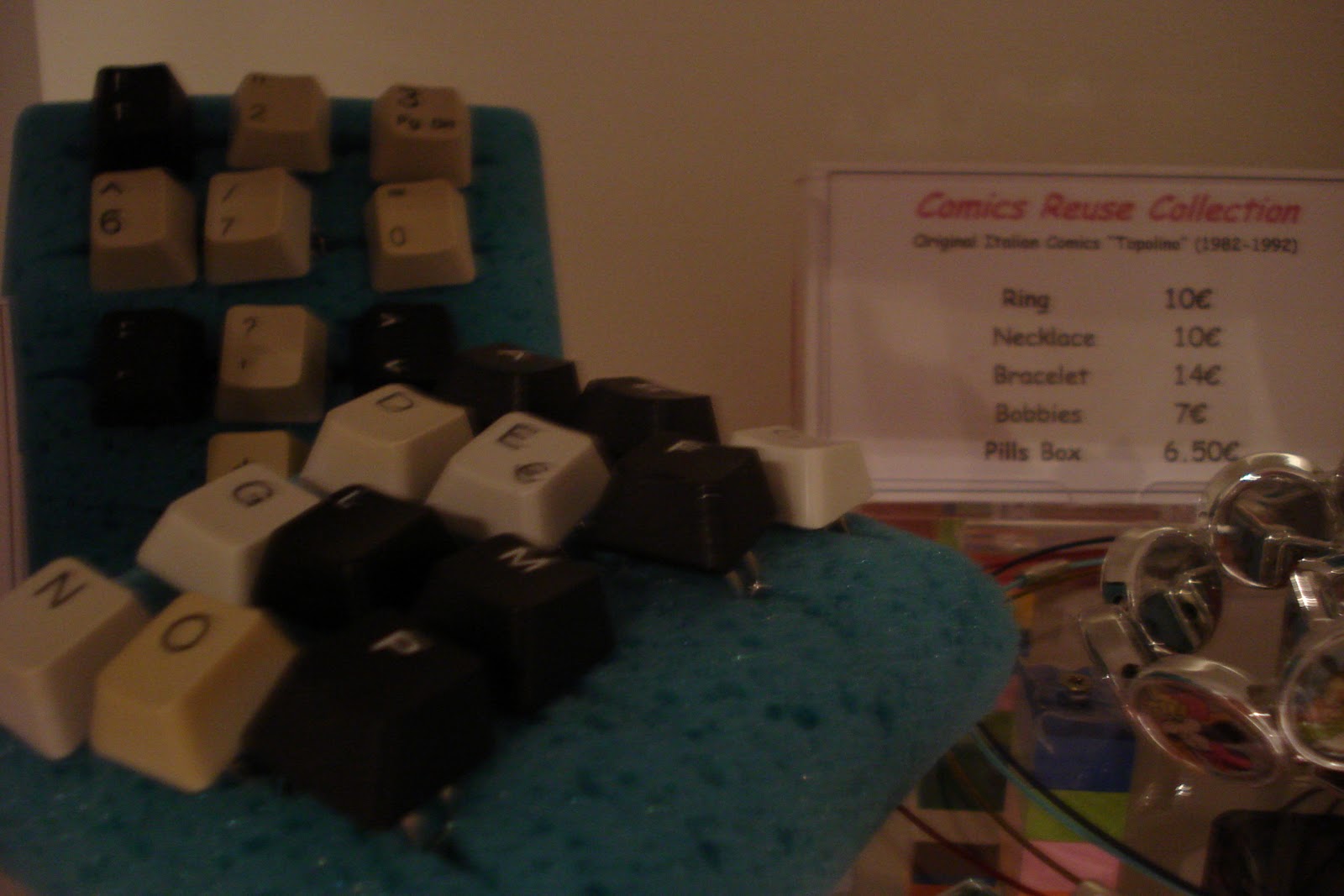
First of all, this is in no way a sponsored post. I am writing this to show my full support in my tiny little way to these amazing creative people and hopefully make this thing grow. I was lucky enough to meet Giulia, the master mind behind this project and have her (while shortly) as a colleague at work. She is a fashion designer and came up with this great new concept. By opening a shop, that actually works more like a gallery, she is connecting creative people. It is a place where any designer can have their own space, a box, in which to showcase (and sell) their work. And because of the nature of the project, this means that the pieces of art (if I dare say) that you will be able to find there will always be different.
 They opened last Thursday, 1st of December, and I was so happy to be able to be there. The whole thing  made me think in the brilliant ideas behind this article on why you should pursue your creativity, and also reminded me of what Liz was saying the other day about working from home: it seems to be " ...the new “American Dream” of our generation- to be able to sit at home in a robe and slippers, refreshing our Etsy shop stats while the coffee brews."
 In short, doing what makes you happy, makes other people happy,  because we are all connected. As Justine put it : "Human beings are wired into each other to an extent that most of us don’t even realize. The mirror neurons in our brain enable empathy: we absorb and reflect what other people are feeling, and their moods influence our moods (which go on to influence the moods of others). This is called emotional contagion."
So if you are in The Netherlands, go visit them (Rozengracht 75, Amsterdam). The pieces they have are truly unique, original, and hand-made.  And if you just want to check it out you can learn more about them here and here.

Thursday, December 1, 2011

Park exploring

 This weekend we found a new park. It is more like a forest. We always passed it with the car and wondered what the place was. Turns out it was part of the city hall of Wassenaar, "Huize de Pauw". This lovely building was constructed in 1556 by Cornelis Arenstsz van der Dussen . At one point it was owned by Prince Frederik of The Netherlands (1797-1881) until it was finally bought by the city.
 I am telling you, it is full of magic. With the statues, gardens, lions and lamp-posts it made me think of something out of The Chronicles of Narnia. Way before the books were made into movies I was fan of the stories, actually read all 7 books. Just take a look come with us.
Source
Some pictures of the place, as it used to be:
*Last two pictures were taken from here.
Related Posts Plugin for WordPress, Blogger...