Now that
I passed the NT2-II (sometimes I still can't believe it) I thought I would put together a list of resources that helped me and also mention those that didn't so much (so you can avoid wasting your valuable time and money). Perhaps it can be useful for someone out there.
-My first formal contact with the Dutch language (other than the loose words that the boy and his family would slowly teach me like names of colors, days and animals, how to say hi, good morning and thank you...) was "
De Delftse methode". This is a class that was developed and takes place at TU Delft (though it is taught in other centers) of which we had only heard amazing stories. People raved about it, about how great it was, about how people went from not saying a word to being able to maintain full conversations after the intensive (3 month) course. So I took it. And it was a waste of money, and not just of a small amount. How to explain this. The
method is based on the premise that small children learn a language by listening and then repeating what they hear, like parrots. So that's what you will have to do. You get a book with CDs, a list of words and written conversations, one per chapter. You listen to these conversations and your task is to memorize them (word by word), understand the meaning of these words, and write them down, literally. This is not a bad exercise per se, if it was not all there was. The method omits to take into account that children, after the parrot phase are sent to school to learn things such as grammar, synthaxis, spelling.... It's mentally retarded if you ask me.
I have to say that your experience with the Delftse Methode is going to highly depend on the professor you get. I know some professors (the one who developed the method) are very good and take their time to actually explain things. But most of them just focus on making the students repeat the texts like
idiots psittacidaes and they do not explain basic things like, say, the conjugation of the verb "to be", the use of auxiliary verbs, or the basic structure of the sentence. Sure, at the back of the book,
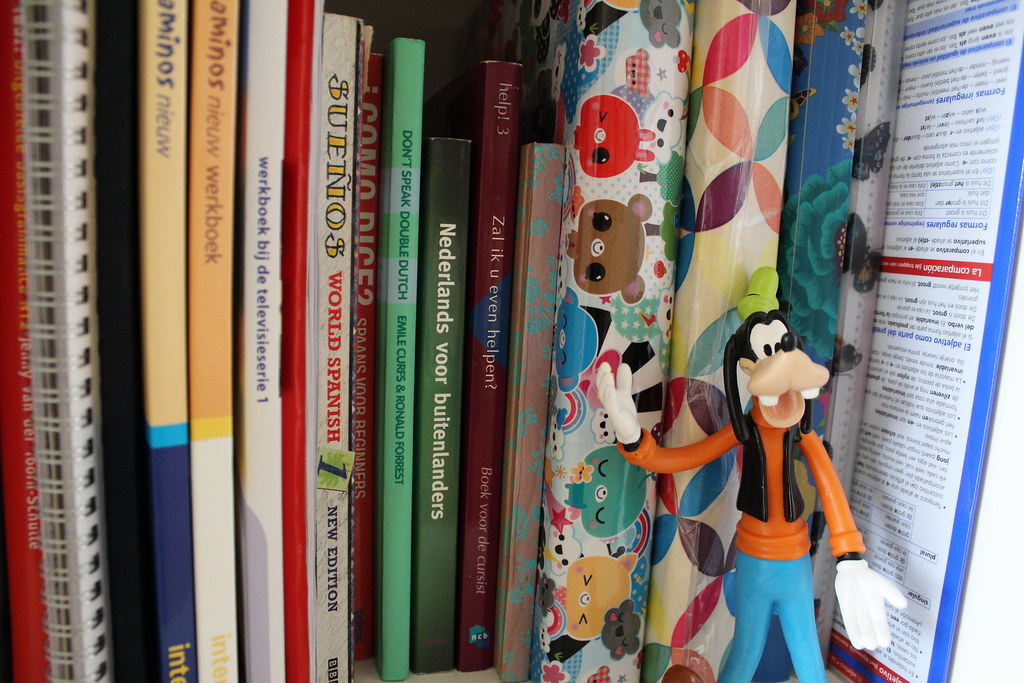
Het Groene boek (Nederlands voor buitenlanders),
(we noemen het boek daarom het groene boek), you'll find a section on grammar but this is never covered or explained in the classes and Dutch grammar is not as straightforward as to just be able to understand it by reading some random conversations. My recommendation with this method, as a first approach only, is to get the book, listen to the cd's and study it by yourself. But by no means pay the money for a course that won't give you any added value or teach you anything else than what is already in the book.The silver lining is that I made some good friends in that class, and I liked going to campus everyday for 3 months.
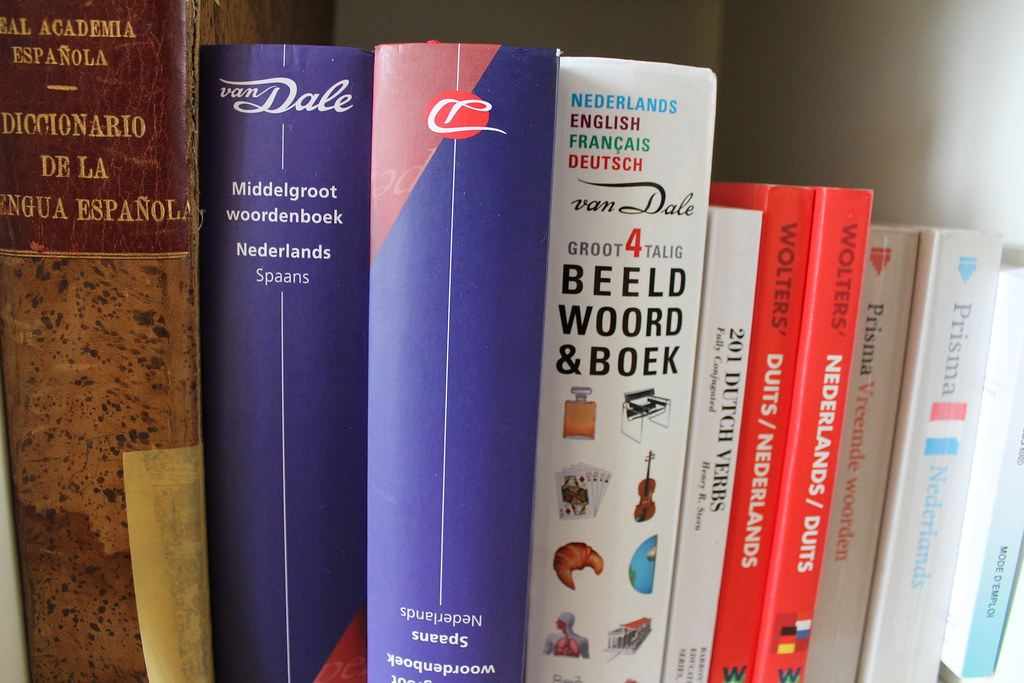
- Invest in some good dictionaries. If you can afford it, don't even bother with pocket or medium size dictionaries and splurge in the biggest, thickest dictionary you can get (the
Van Dale's are the best). You will keep on using them. As an extra I got the "
Van Dale groot 4 talig beeld woord & boek", it's basically a pictionary. It is full of drawings of things and its name in 4 languages (English, French, German and Dutch). And get yourself a book of conjugations. It is very handy to have a little book where all verbs in all tenses are easy-to-find and it helps you understand how the rules and exceptions of conjugations work. I got the
"201 Dutch verbs fully congujated" by Henry Stern and I was very happy when I found such a book (It took me a while to find it... I knew such a book in French,
la conjugaison, by Bescherelle, and unfortunately this specific one does not exist in Dutch).
- Go to classes. To good ones. This is where I get to recommend my school, and my dear professor Petra. If you are in the area, make sure you ask for her, and enroll in one of her courses because she is really, really good (not to mention fun, crazy and chaotic, all great qualities in my book). In the end where I really learnt was at
Direct Dutch. I took the intermediate, advanced and NT2-II courses. Right from the start the method focuses on conversation without leaving the rules behind. It was here that the mysteries of how to structure a sentence in Dutch were finally revealed to me. This is how it works: you will get some class material and cd's. You can choose between intensive courses or 1 time per week 2h 30 classes. I chose the latter because at the time I was working. Before every lesson you have to read a newspaper and prepare a short summary of it to present it at the class. The idea is to get you talking, but don't worry, it's usually less than 5 minutes and these presentations are done at the end of the class, so the ice has been broken, so to speak. For the intermediate courses the online newspaper
nu.nl was enough, for the advanced classes we could chose from one of the main newspapers (
de Volkskrant (my fave),
de Telegraaf or de
NRC). Every week we also had grammar exercises (from the class materials) that were reviewed during class and you had to write a short composition (on any subject you wanted, though there were also guidelines) of 100-150 words. During the class after explaining the grammar as was needed and going through the exercises we mostly talked. The fact that we had to read, write, talk and study beforehand made all the difference.
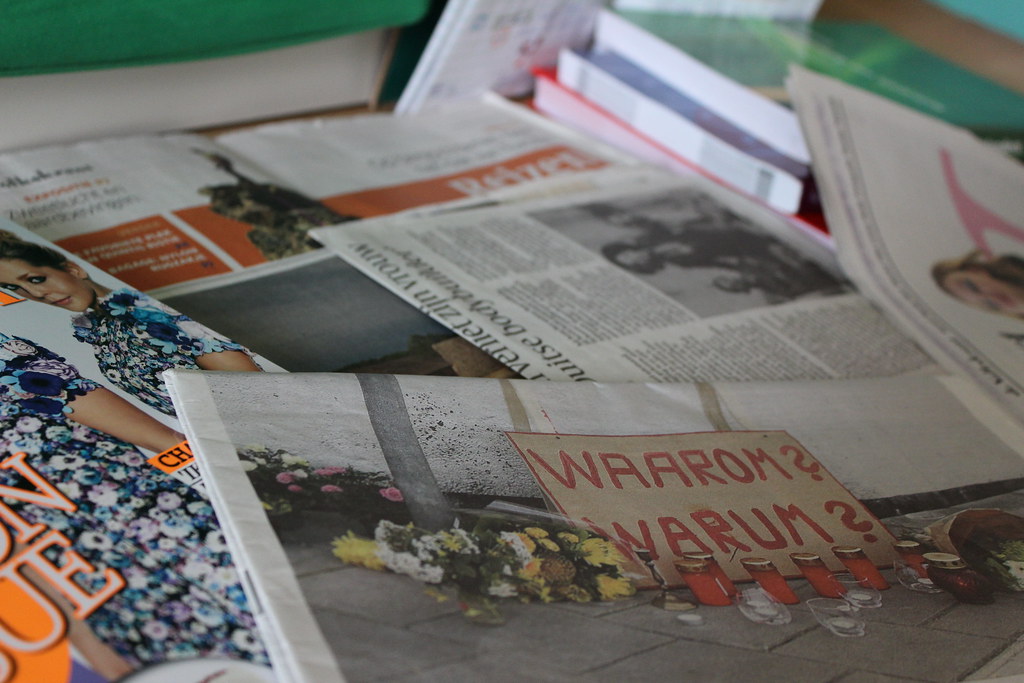
-Get immersed in the culture. Watch TV. Listen to the radio. Visit museums and art galleries. Even seemingly "silly" stuff can help. I got a good deal for a 4-month subscription to
Grazia magazine and I read all of it. If celebrity gossip and fashion aren't your thing just choose something that appeals to you (interior decoration, games, computers, cooking). I also found the videos from
schooltv.nl very helpful. Sure, they are meant for kids from grades 1-8, but they are simple, easily understandable, cover a wide range of subjects that you can choose from and the ones for the junior-high school kids are very interesting and often take 15 minutes, which is a good length. Not too long, not too short. I also loved learning some songs from the Dutch children's singing competition: "
kinderen voor kinderen" ('...op een onbewoond eiland lekker leven is de leus').
--------------------------------------------------------------------------------------------------------------------
Update I should have mentioned here: listen to Dutch music, try to write down the lyrics (I like Dio and Cef): Tijdmachine and De wereld in are really catchy songs.Partysquad has some fun numbers too (don't mind the swearing). I like Ik ga hard and Helemaal naar de k****. Don't judge, the boy shows me this music. And, again, the newspaper De Volkskrant has a dossier- series called "Der Nederlanden", that talks about all kinds of subjects around "Dutch-ness", from the use of the bike, to the food they like or historical figures, games and traditions.
---------------------------------------------------------------------------------------------------------------------
-Finally two books that I found helpful were
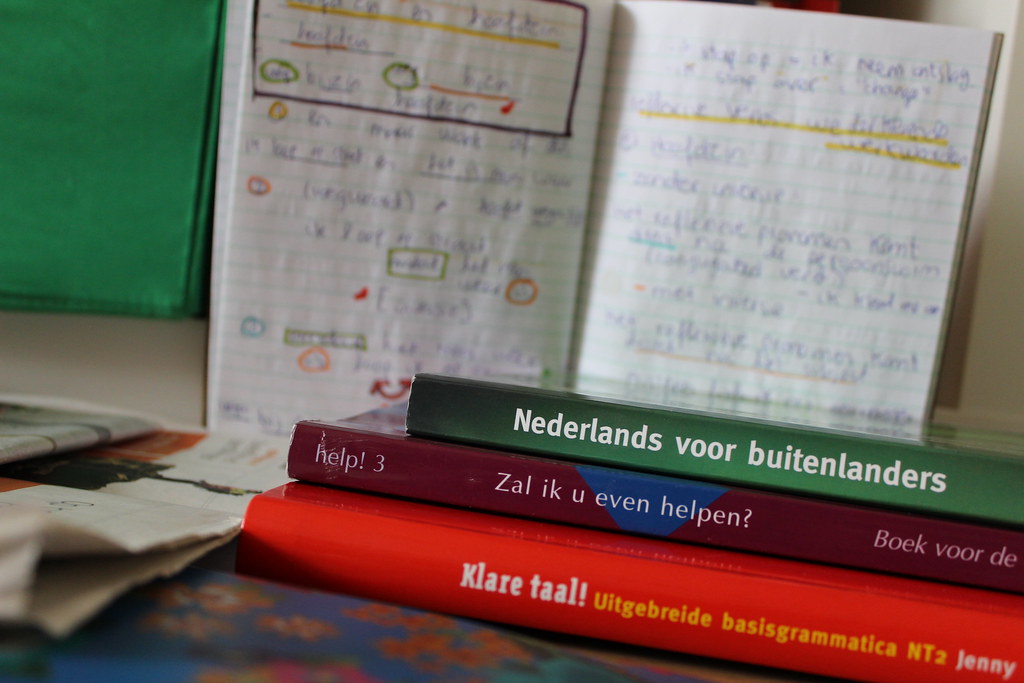
Klare taal, uitgebreide basisgrammatica voor de NT2 (Jenny van der Toorn-Schutte), which starts at a very basic level and is full of exercises and clear explanations and
Help! 3 Zal ik u even helpen (which we used in the preparatory class for the NT2-II). The
intertaal grammar summary (which looks like a simple plastic folder) was extremely useful, concise and helpful. (The name of this booklet is "Grammaticawijzer", it is produced by
Intertaal and it is available in many different languages.)

At first Dutch sounds very different and the order of the sentences is confusing (many times you will only find the verb at the end of the sentence, and inversion of the subject is common). But slowly you will see that it is in ways similar to English, French, even Spanish (some words are the same) and of course to German and Nordic languages (but that was not helpful in my case because I have no basic knowledge in any of those). You will often get frustrated because at the beginning the learning process is fast, and then you seem to reach a point where you are stuck. Where you are not learning anymore, where you seem to be making no progress. I think this is where you absorb and really learn. Because after that, I promise you, if you keep your efforts, there'll be a click, and suddenly you will find it easier to start talking, you will notice you understand people around you, you will lose the fear. And I am not saying I am fluent here, I still have a lot to learn. I want to be able to write, manipulate and twist language to make pretty sentences like I am able to do in Spanish, French or English. I am not there yet, far from it. But from here it is a matter of keeping at it, of reading books, making the effort to speak Dutch with the boy (ahem, we keep forgetting after a few hours of doing so).
Do you have any tips for learning a new, different and seemingly incomprehensible language?
*
Marktplaats is a great place to find second-hand books (or anything else for that matter). We got my Spaans-Nederlands, Nederlands-Spaans big dictionaries above for 40 EUR (instead of 90 EUR) and they are brand new.